What epilogue for a beginning?A smile is stamped on my face, but more than a smile it is a contraction of my features. I open my mouth to breathe in all the air I can. The smile, instead, is the expression of the effort made up to that moment. The physical effort is at the same time a psychological effort, a use of mental resources I didn't think I had. And while my face contracts into this grimace of pain and happiness, the first tears start to come. I can't hold them back, they burst out like an unstoppable avalanche, they sweep everything away, shattering what is left of my battered soul... PrologueIt is four in the morning, I hear my two-year-old daughter whimpering in her cot. She has had a fever for a few days and it shows no sign of coming down. But the whimper fades, shapeless, into the night. I float between sleep and waking, paying only half attention to that whimper. In the dark the sound takes on a material form, it is almost angular, undoubtedly irritating, and it goes on until I hear my partner get up to go and look. Good..., or rather, bad!In my head everything happens in the indefinite instant of a click. The decision is made automatically. I sit on the edge of the bed, I rub my face with my hands to get the blood moving in the capillaries. We're going to the hospital. It certainly looks like shaping up to be a dreadful day. The way the whole situation has come about is just the icing on the cake. I have recently opened a new bookshop and I have given everything I have to get the business off the ground. These have been the hardest months of work of my life. My body, but above all my mind, are worn out by tiredness and by a strange kind of repression caused by my relentless work commitments. It is the kind of exhaustion that builds up when you sleep only a few hours: it makes you fragile right down to the bone. A tiredness so deep-rooted and profound that in the morning, when you wake up, you don't even have the strength to open your eyelids. The brain still works, but the body stubbornly refuses to respond. When we go outside it is still dark, but the dry winter cold doesn't bother us too much. I look at my wife lovingly keeping the baby entertained and I feel her strangely distant, as though she belonged to a different world. But perhaps, more simply, it is I who belong to a world different from hers, from the world of people who are, so to speak... “normal”... this is exactly what I was saying, in fact: I have a difficult character, at times moody and withdrawn. My thoughts are interrupted when at last we are called... |
{tab=Departure}
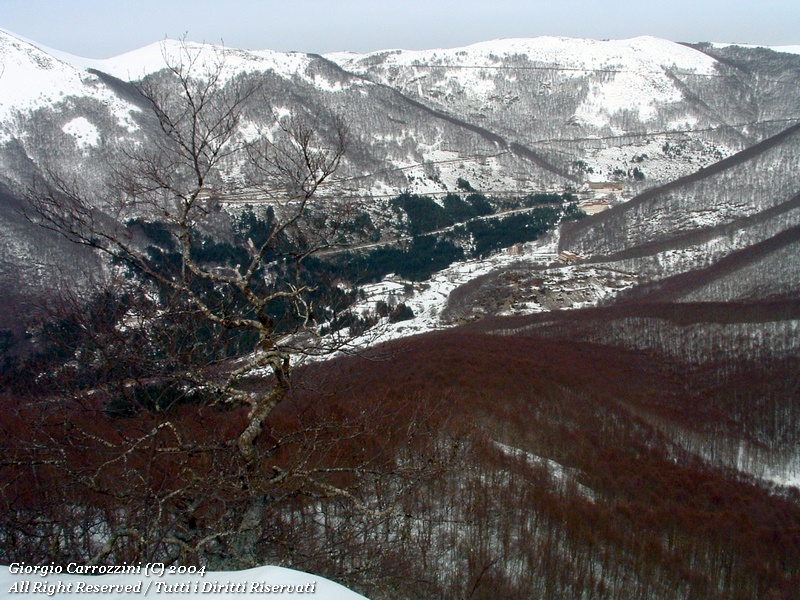
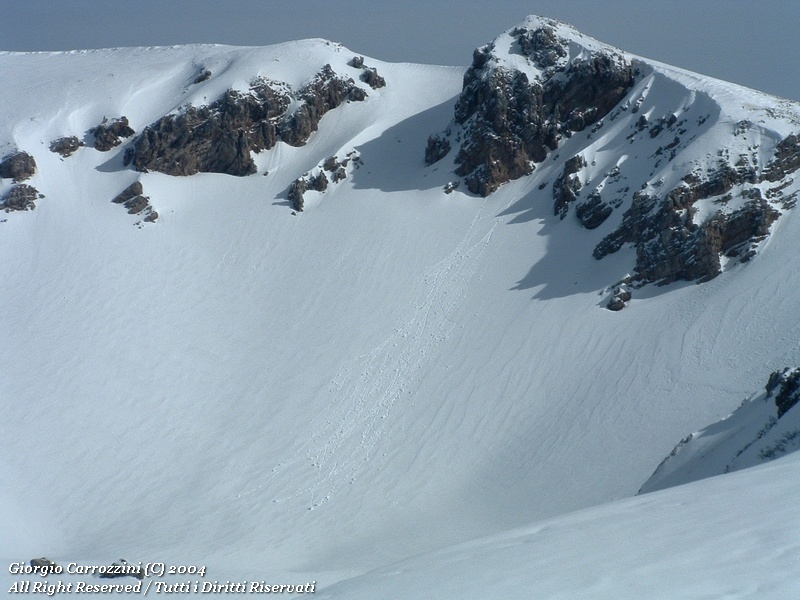
DepartureWe are back home again. The doctor has examined the baby. He was very meticulous, but in the end he smiled at us kindly and said it was just an ordinary cold. As I watch the doctor, he seems to be talking to me in slow motion, everything unfolds like an endless action replay. And as he talks and explains that ours was just the anxiety of young, inexperienced parents... these words have the effect of a cold shower, I almost feel as if the world were turning upside down. Everything seems to take on a grotesque look, bordering on the paradoxical. The doctor says goodbye, sending us home with a hearty pat on the back and every good wish for the lovely baby. It is seven in the morning. Sleep has vanished by now, so all that's left is to decide how to spend this day that started too early and on such strange premises. I don't think about it for long, the mental process is simple, it looks like a mathematician's operation. Two plus two equals four. Free time equals mountain. So even though it is already very late I decide to set off for Monte Viglio. So, leaving my wife and daughter, partly without remorse, I decide to set off for the Monti Simbruini. For this Sunday, which began at first light, once again I have the chance to live yet another of my little hiking escapes. I get out of the car; on the ground the snow has frozen, and when I tread on it it crunches, making a pleasant noise under the soles of my boots. I rub my hands together, it is a wonderful feeling, the icy cold gives me the thrill of... of being so... alive. When I look up at the mountain, in front of me rises the broad western flank of Monte Viglio. On the left the line of the ridge is broken by the great rocky tooth of the Gendarme, on the right the rocky slopes of Monte Viglio and the wide Circo dei Sassoni. At the foot of this low mountain mass, the immense, sleeping beech wood so typical of the Apennines. I get dressed quickly and in less than ten minutes I am already immersed in nature. |
{tab=Getting lost}
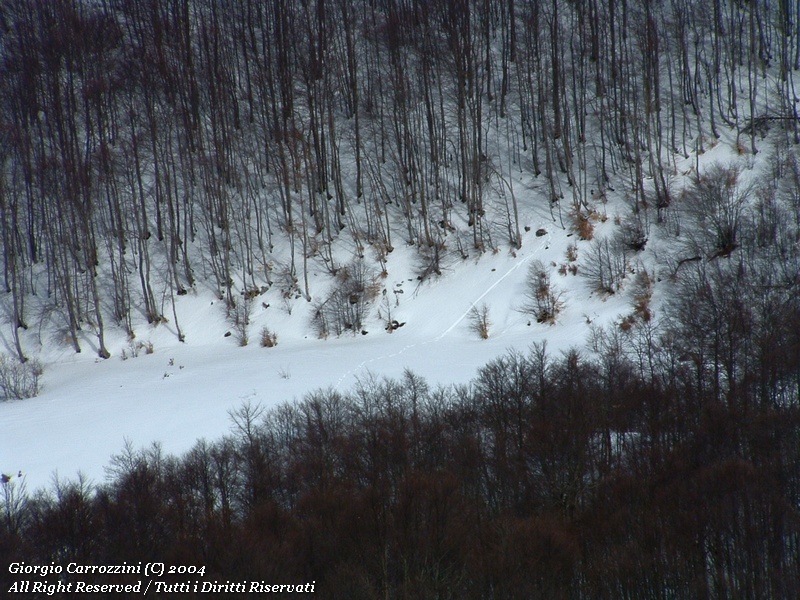
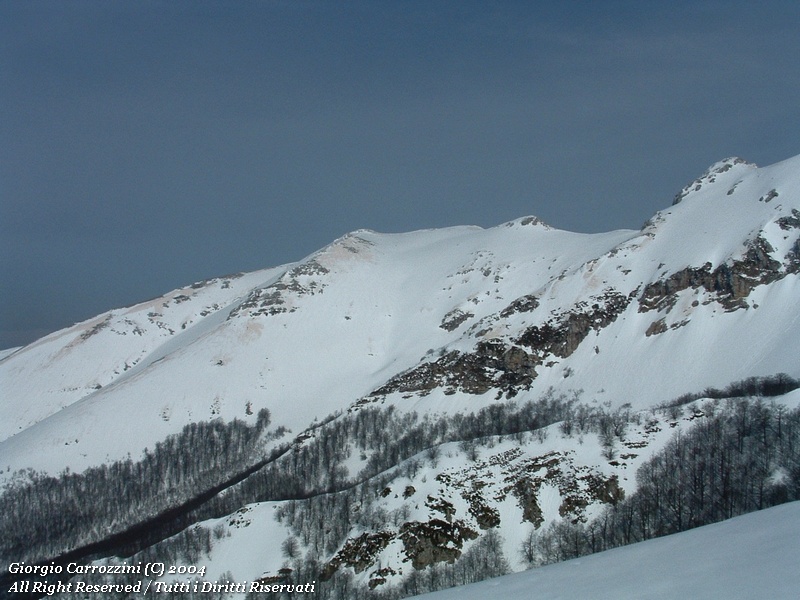
Getting lost...I studied the map for weeks; now that I am, as it were, lost in the living heart of nature, this crumpled piece of paper looks almost unreadable to me. I try to make sense of the curves of the surrounding relief and to match every contour line to a profile, a height, a hill. I am still deep in the beech wood and I try to gain as much height as possible, but I soon find I am forced to move south: I have to cross a low hill to get into the wide glacial cirque, the Circolo dei Sassoni. Over the hill I find myself in a broad clearing from which I can make out the direction to follow better. I am still too wrapped up and this makes me sweat quite excessively. I keep a few clumsy self-timer photos as an everlasting token of those moments. My face, gaunt and tense, has the red flush of physical effort. There is no smile, and yet, I remember it well, it was a subtle and priceless pleasure to be there at that moment. I was full of satisfaction and at the same time emptied of all thoughts of everyday commitments. The stop, for a tea that is still good and hot, doesn't last long. On the summit two dark shadows are moving about; I don't think they have noticed me: at about 1700 metres I am still deep in the beech wood and the two hikers are unlikely to be able to see me. Through the bare trees I can see the line of the ridge rising to the top: it has the pure white of the snow, it follows the light line of freedom. Once I reach the ridge, I think, the climb will certainly be easier. No more questions in the search for the route, no more fighting against the thick of tangled branches. No more needless worries. The clean line of the ridge will take me straight to the summit without new detours, without fears. |
{tab=A matter of perspective}
A matter of perspective...When the last trees thin out I have practically reached the ridge. From here I can see the whole immense beech wood I have come through so far, I can better measure the effort, every single branch I had to climb over, every single tree I had to get round. From here I can recover a sense of time that I had lost in the wood. I know that ridges swept by the wind are often free of snow. Or in some cases the frozen snow is as solid as concrete and with a good pair of crampons you go up without too much effort. That is how my adventure began. I have always read a lot, above all fiction, from science fiction to the contemporary classics. In recent years I had sensed that faint taste of the implausible present in made-up stories. It was an aftertaste that, as I read, became more and more unpleasant. I had the impression that all this could not really enrich me, but rather helped to increase my already innate confusion. Through the bare trees I can see the line of the ridge rising to the top: it has the pure white of the snow, it follows the light line of freedom. Once I reach the ridge, I think, the climb will certainly be easier. No more questions in the search for the route, no more fighting against the thick of tangled branches. No more needless worries. The clean line of the ridge will take me straight to the summit without new detours, without fears. |
{tab=The summit}
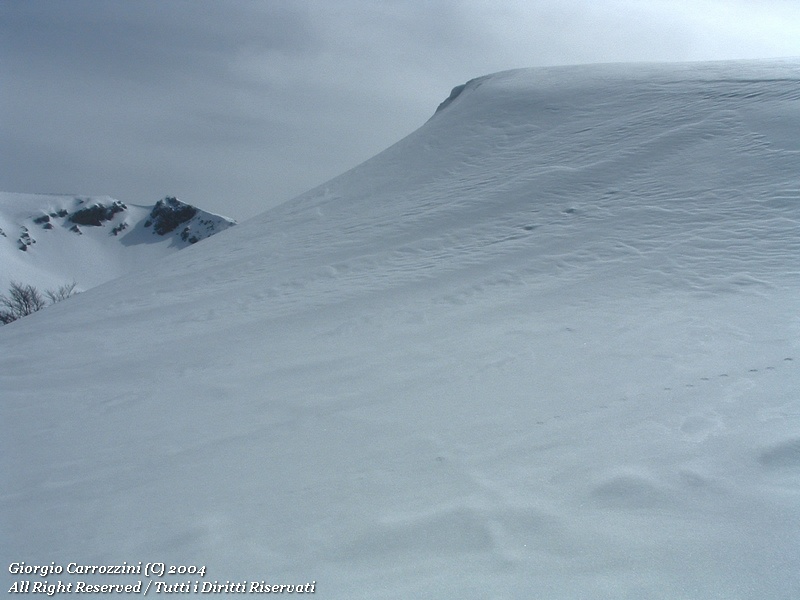
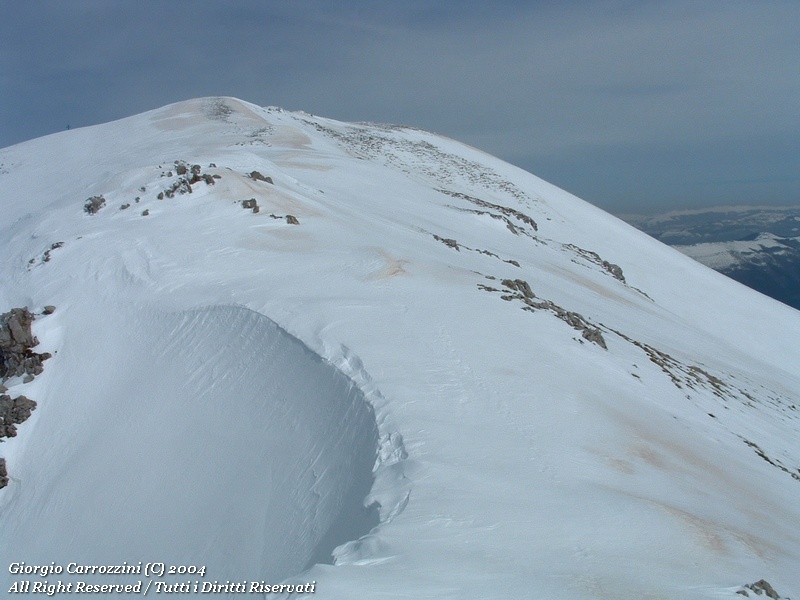
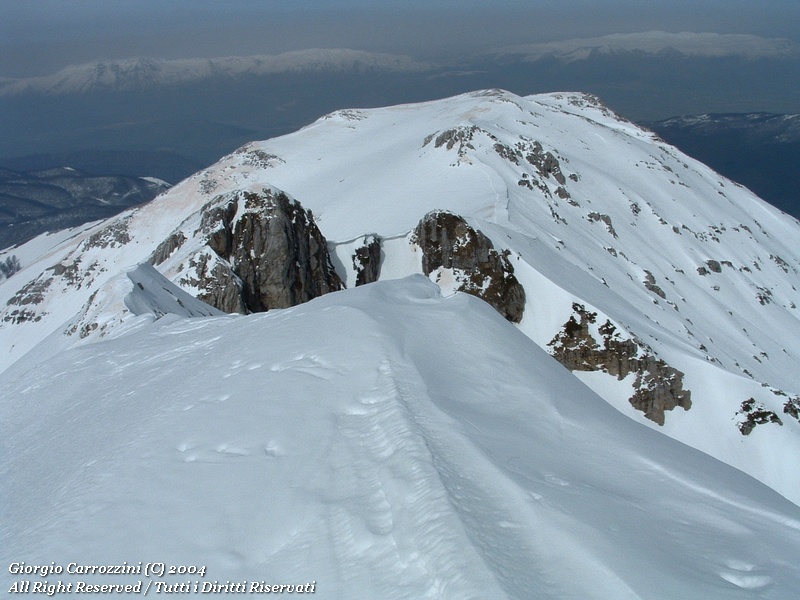
The summit...Veiled by a blanket of white cloud, the sky can't seem to make up its mind to open. A light wind blows from the south; for March it isn't very cold. And in fact when I finally reach the line of the ridge I find that the snow isn't frozen at all; on the contrary, you can see the first red patches of magnesite absorbed by the snow, the sign that the snow is inevitably melting. Instead of bringing me closer to the summit, though, the ridge seemed to have taken me further away from it. The snow, still very soft, kept hindering my steps. Because of a sharp pain in my left hip I had to stop more and more often. This is what happens to the Sunday hiker who, without any training, decides to climb more than a thousand metres of height gain in deep snow. The optical effect of perspective had flattened the depth of field. The ridge was in fact turning out, before my eyes, to be much longer than expected. Three steps and I had to stop. The pain was getting stronger and stronger, unbearable. There is no turning back now: there was still all the time in the world and no technical difficulty on the climb: no tricky moves, no route-finding problems. All I had to do was put up with the pain and keep going. When the pain becomes insistent and unbearable you can't help drawing the parallel with the difficulties of existence in general. Your mind sets off on a merry-go-round of abstract thoughts. Conquering a summit lends itself wonderfully to the comparison with life. You can do nothing but keep going. It takes endurance, stubbornness, control. At 2050 m I meet the ridge coming from Monte Pratiglio. The view is wonderful, but I keep my head down and don't pay it much attention: I am tired and entirely focused on managing the pain in my hip in my head. I look up and see the distinct shape of the summit cross. It is huge, and at last I begin to understand its real proportions. Step by step, and with an almost exasperating slowness, I reach the little round plateau at the foot of the summit. I look up: only the last 20-metre pull to the cross is left. As I climb the last few metres to the cross I sob convulsively; an unstoppable river of thoughts and memories resurfaces into consciousness, into the vivid light of awareness, and all together they take shape, composing a single, perfect image of my existence. From an upper pocket I take out a photo of my daughter and wedge it on the cross. The real meaning of this gesture still escapes me. Perhaps all this is just for my outsized ego. The cross, the wonderful view, reaching this goal, these few hours alone serve only myself. A small thing, when I think that to this daughter I am devoting my nights, my days, my time, my life. Being here... perhaps... I have earned it... at least this time. With effort and stubbornness I had achieved the goal of gaining the summit of that mountain. Not only had I managed to reach it from the most tiring side, on one of those days that seemed to bode nothing good. I had also managed to make that conquest clarify for me the meaning of my daily toil. From the summit of daily sacrifice you can look back on your own existence with satisfaction and pride. That's what a summit is. That's what life is. |
{/tabs}
Photo gallery






Fact sheet
- Hike fact sheet
Fact sheet not yet available...